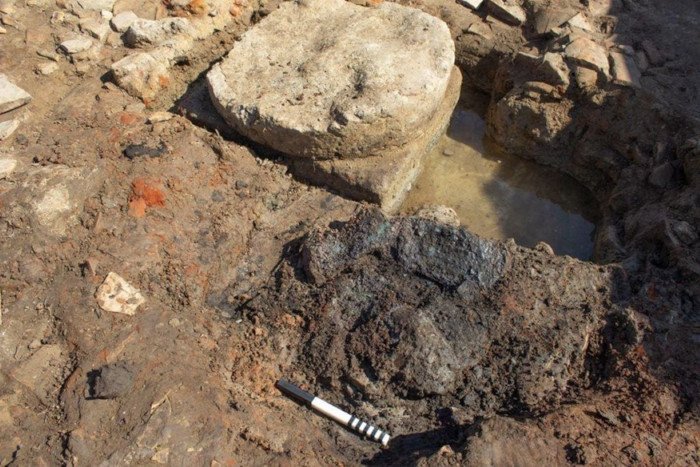

Recent excavations at a 6th-century BC temple in western Greece have unearthed compelling evidence suggesting that some ancient sanctuaries were more than just places of worship. A team of archaeologists believes the striking temple at Kleidi-Samikon, in the Peloponnese region of Ilia, may have also functioned as a repository for official documents, effectively serving as an ancient archive.
The discovery, made during the 2025 excavation season, centers on a collection of heat-damaged bronze sheets found clustered on the floor of the temple’s northwestern hall. This find, combined with a large bronze inscription discovered in the same space in 2024, strongly indicates that the room was used to store written records . In ancient Greece, important civic and sacred documents, such as laws, treaties, and official records, were often inscribed on metal sheets and kept in the secure, hallowed grounds of a sanctuary.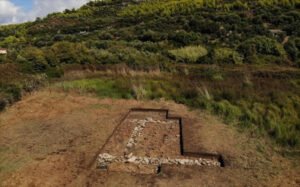
An Unconventional Temple Layout
The temple itself, first uncovered in 2022, has long puzzled researchers with its unusual design. Measuring approximately 28 meters (92 ft) long and 9.5 meters (31 ft) wide, the Archaic period structure features two large, distinct halls, each with a central colonnade. This double-chamber layout is highly atypical for the religious architecture of the time and led researchers to theorize that the two spaces served different functions.
According to a Greek Reporter article, the recent discoveries seem to confirm this hypothesis, pointing to the northwestern hall’s role as an administrative center within the sacred complex. The Greek-Austrian research team, co-directed by Dr. Birgitta Eder of the Austrian Archaeological Institute and Dr. Erofili-Iris Kollia of the local Ephorate of Antiquities of Elis, removed a thick layer of collapsed Laconian roof tiles to reveal the building’s floor, which bore clear traces of a fire that destroyed it in antiquity .
Clues Preserved in the Destruction
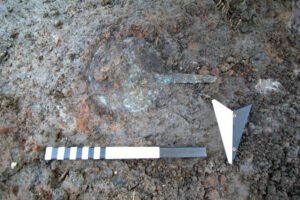
Paradoxically, the fire that devastated the temple in the first half of the 3rd century BC also created a time capsule for archaeologists. The collapse of the roof sealed the contents of the hall, preserving artifacts in their final positions. Among these were the charred bronze sheets, a bronze mirror, several coins, and a fascinating steatite seal from the 4th century BC depicting a young woman bathing—a motif possibly linked to the worship of the local Anigriades Nymphs .
This sanctuary is believed to be the one dedicated to Poseidon, the Greek god of the sea, mentioned by the ancient geographer Strabo. Its location near the ancient city of Samikon in Triphylia was a strategic hub and the center of a regional political alliance, making it a logical place for an official archive .
Reconstructing a Monumental Past
The 2025 season also yielded fragments of a large terracotta disc acroterion, an ornament that once crowned the temple’s roof. Researchers estimate the disc was at least one meter in diameter and decorated with black and red paint, indicating the building had a visually impressive and monumental appearance. The discovery of a nearly complete marble perirrhanterion, a ritual water basin, in 2024 further attests to the sanctuary’s importance.
The ongoing five-year research project (2022-2026) continues to shed light on the history and function of this significant site. Each discovery at Kleidi-Samikon brings us closer to understanding the complex interplay of religion, politics, and administration in the ancient Greek world, revealing that even a temple dedicated to a powerful god had practical matters to attend to.