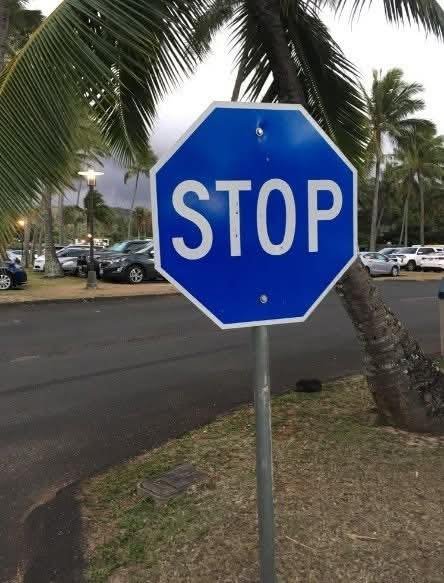

Most drivers instantly recognize the classic red stop sign as one of the most important symbols on the road. Its bright color and bold lettering are designed to demand immediate attention—and on public streets, ignoring one can result in serious legal consequences. But occasionally, drivers report seeing a blue stop sign instead. While uncommon, these signs do exist, and they serve a very different purpose.
Why Red Stop Signs Are Standard
On public roads throughout the United States and many other countries, stop signs follow strict design standards. In the U.S., for example, the red octagonal stop sign is regulated under the Federal Highway Administration’s Manual on Uniform Traffic Control Devices (MUTCD). The red color was chosen because it signals danger and commands attention, ensuring drivers understand that stopping is mandatory.
Failure to obey an official red stop sign can result in traffic citations, fines, and even points on a driver’s license. These signs are legally enforceable because they are installed by government authorities and governed by traffic law.
Where Blue Stop Signs Appear
Blue stop signs, on the other hand, are typically found on private property, not on public roadways. You may see them in places such as:
-
Gated residential communities
-
Shopping centers and retail parking lots
-
Industrial parks
-
Private campuses or business complexes
Because these locations are privately owned, the signage is not always required to follow the same federal standards as public roads. Property owners sometimes choose alternative colors—including blue—for aesthetic reasons or to match a development’s branding or design theme.
Are Blue Stop Signs Legally Enforceable?
In most cases, blue stop signs do not carry the same automatic legal authority as official red stop signs installed on public roads. Since they are placed on private property, enforcement can vary depending on local laws and agreements with law enforcement agencies.
However, that does not mean they should be ignored. These signs are usually installed to:
-
Improve traffic flow
-
Reduce the risk of collisions
-
Protect pedestrians
-
Enhance overall safety in high-traffic private areas
Ignoring them could still result in consequences, especially if an accident occurs. In some areas, local law enforcement may have authority to enforce traffic rules on certain private properties open to the public.
Why the Color Difference Matters
Color in traffic signage is highly intentional. Red universally signals “stop” or “prohibition” in road systems. Blue, by contrast, is commonly associated with informational or service signage—such as rest areas or hospital directions. When used on a stop sign in a private setting, the blue color helps distinguish it from official government-regulated roadway signage.
That distinction is important because it clarifies jurisdiction and enforcement while still encouraging safe driving behavior.
The Bottom Line for Drivers
Even if a blue stop sign may not be legally identical to its red counterpart, it serves an important purpose. Drivers should treat it with the same level of caution and respect. Private property can still present serious traffic hazards, particularly in crowded parking lots or residential areas where pedestrians and children may be present.
In short, while blue stop signs are uncommon and typically non-regulatory, they are installed with safety in mind—and stopping is always the safest choice.