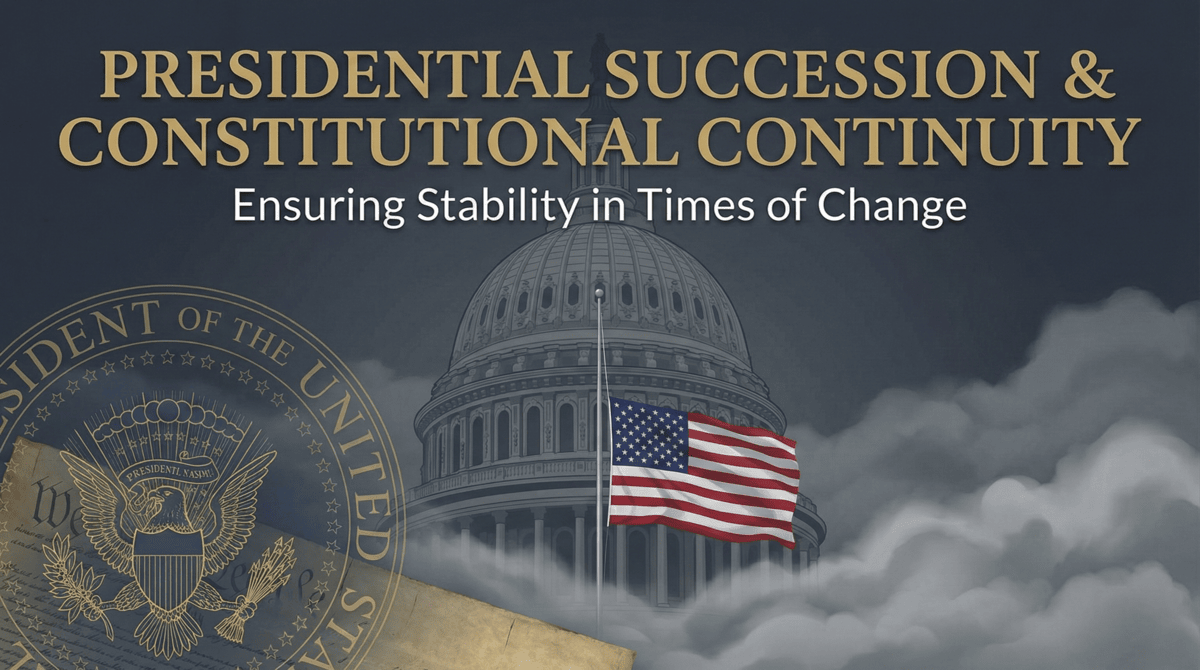

The Constitutional Framework: The 25th Amendment
The foundation for presidential succession lies in the 25th Amendment to the U.S. Constitution, ratified on February 10, 1967. This amendment was enacted following the assassination of President John F. Kennedy in 1963, which exposed critical gaps in the original constitutional succession rules.
Section 1 of the 25th Amendment clearly states: “In case of the removal of the President from Office, or of his Death, Resignation, or Inability to discharge the Powers and Duties of the said Office, the Vice President shall become President.”
This language is unambiguous and mandatory. Upon the president’s death, the succession is automatic and immediate—there is no interim period, no acting president, and no time delay. The vice president does not assume acting duties; they literally become the President of the United States.
Prior to this amendment’s ratification, this practice had been established through tradition rather than explicit constitutional language. Now, it is the supreme law of the land. The amendment also established provisions for:
- Section 2: Filling vice presidential vacancies through presidential nomination and congressional confirmation
- Section 3: Procedures for temporary presidential disability
- Section 4: Processes for removing a president deemed unable to discharge duties
JD Vance: Trump’s Vice President
Since January 20, 2025, JD Vance serves as the 50th Vice President of the United States under President Donald Trump. Understanding who would immediately assume the presidency is crucial to this discussion.
Who Is JD Vance?
JD Vance (born James David Bowman) is a 40-year-old former U.S. Senator from Ohio and the first Marine Corps veteran to serve as Vice President. His background includes:
- Military Service: Completed a six-month tour in Iraq (2005) as a noncombat military journalist with the Marines
- Education: Graduated from Ohio State University and Yale Law School
- Career: Transitioned from law to technology and venture capital, founding his own VC firm in California
- Political Career: Served as U.S. Senator from Ohio before being selected as Trump’s 2024 running mate
Vance was formally inaugurated as Vice President on January 20, 2025, and has taken on several significant roles, including Finance Chair of the Republican National Committee.
Vance’s Immediate Ascension
If Trump died while in office, Vance would not need to be elected or appointed—he would automatically and immediately become President. This is not a ceremonial formality; it is a constitutional fact that takes effect the moment Trump’s death is confirmed.
The Immediate Timeline: What Happens First
The first hours and days following a presidential death involve a carefully choreographed sequence of events designed to maintain government continuity while acknowledging the gravity of the situation.
Hour 0-1: Confirmation and Announcement
Once Trump’s death is confirmed (whether by medical professionals, the White House physician, or other official sources), the White House Counsel and senior staff would immediately secure the death scene and initiate protocols. The first public announcement would not come through social media or rumors—it would come through an official White House statement or presidential proclamation from Vice President Vance.
This is critical: in the modern era of viral misinformation, the U.S. government has learned that clarity and speed are essential to preventing panic. Multiple authoritative sources—the White House, major news networks, congressional leadership—would simultaneously confirm the death.
Hour 1-3: The Oath of Office
Within hours, JD Vance would take the Oath of Presidential Office. This oath could be administered by:
- The Chief Justice of the United States (preferred, for symbolic weight)
- Any federal judge
- Any authorized official
Historically, Vice President Lyndon B. Johnson was sworn in aboard Air Force One less than two hours after President Kennedy’s assassination on November 22, 1963—a powerful symbol of governmental continuity in crisis.
Once the oath is taken, Vance would assume:
- Command of all U.S. Armed Forces
- Control of nuclear launch codes
- Authority over all executive branch agencies
- Power to sign legislation or issue executive orders
- Diplomatic authority as Head of State
Hour 3+: Securing the Government
Simultaneously with the oath-taking, several actions would unfold:
- National Security: The Secretary of Defense would immediately brief the new president on any national security threats
- Nuclear Codes: The nuclear football (the briefcase containing nuclear launch codes) would be transferred to the new president’s military aide
- Cabinet Notification: Cabinet members would be notified and may convene for a transition briefing
- International Notification: The State Department would officially notify world leaders and foreign governments
- Market Operations: If the death occurs during market hours, trading on U.S. stock exchanges would be suspended to prevent panic selling and allow market adjustment time
The Presidential Succession Line: What If Vance Were Also Incapacitated?
While JD Vance would assume the presidency, the Constitution requires that a line of succession exist in case multiple leaders are incapacitated simultaneously. The current line of succession is established by the Presidential Succession Act of 1947:
Current Line of Succession (as of 2025)
- Vice President: JD Vance (would become President)
- Speaker of the House of Representatives: Mike Johnson
- President Pro Tempore of the Senate: Mitch McConnell
- Secretary of State: Marco Rubio
- Secretary of the Treasury: Scott Bessent
- Secretary of Defense: Pete Hegseth
- Attorney General: Kristi Noem (or current AG)
- Additional Cabinet secretaries in order of departmental establishment
This succession order ensures that there is always an identified leader prepared to assume the presidency, even in scenarios of mass casualty events affecting multiple government figures.
The “Designated Survivor” Protocol
To ensure succession line continuity, the U.S. government employs the Designated Survivor protocol. During high-risk events where many succession-line figures gather (State of the Union addresses, presidential inaugurations, etc.), at least one senior cabinet official is assigned to a secure, undisclosed location. This ensures that if a catastrophic event kills or incapacitates multiple leaders, there remains someone constitutionally eligible to assume the presidency.
The responsibility for tracking succession-line members falls to FEMA’s Central Locator Service, which maintains daily records of where each official is located.
Historical Precedent: Previous Presidential Deaths in Office
The United States has experienced eight presidential deaths in office since 1789—a sobering reminder that this is not merely a theoretical scenario. Understanding these precedents provides insight into how the nation has handled such crises.
Deaths from Natural Causes
William Henry Harrison (April 4, 1841)
- Served only 30 days before dying, likely from pneumonia or typhoid fever
- Succeeded by Vice President John Tyler
- This succession established the precedent that the VP becomes President, not Acting President
Zachary Taylor (July 9, 1850)
- Died from acute gastroenteritis (possibly cholera)
- Succeeded by Vice President Millard Fillmore
- Both Harrison and Taylor died at the White House itself
Warren G. Harding (August 2, 1923)
- Died from a heart attack or cardiovascular event
- Succeeded by Vice President Calvin Coolidge
- Coolidge became known for fiscal conservatism and tax cuts
Franklin Delano Roosevelt (April 12, 1945)
- Died from a cerebral hemorrhage during his fourth presidential term
- Had just begun his term and was in the midst of World War II
- Succeeded by Vice President Harry S. Truman, who faced the decision to use atomic weapons
Deaths from Assassination
Abraham Lincoln (April 15, 1865)
- Shot by John Wilkes Booth on April 14; died the following morning
- Succeeded by Vice President Andrew Johnson
- The New York Stock Exchange halted trading for an entire week
James A. Garfield (September 19, 1881)
- Shot on July 2, 1881, and lingered for 79 days before dying
- Unique among assassinations in that markets had months to adjust
- Succeeded by Vice President Chester Arthur
William McKinley (September 14, 1901)
- Shot on September 6; died eight days later
- Succeeded by Vice President Theodore Roosevelt
- Roosevelt’s pro-trust-busting policies caused a significant 6.2% stock market decline upon McKinley’s death (as investors feared policy shifts)
John F. Kennedy (November 22, 1963)
- Shot in Dallas; died 30 minutes later at Parkland Hospital
- The most recent presidential assassination
- Succeeded by Vice President Lyndon B. Johnson, sworn in aboard Air Force One
- The S&P 500 dropped 2.8%, but recovered all losses within two trading days
The Stock Market and Economic Impact
One of the most immediate and measurable effects of a presidential death is the reaction of financial markets. Historical analysis reveals clear patterns.
Historical Market Reactions
Based on the four presidential assassinations:
- Average decline: Approximately 1.6% across all four cases
- Fastest recovery: Kennedy’s assassination (2-3 days to full recovery)
- Most significant decline: McKinley’s death (6.2% drop, due to policy uncertainty regarding his successor Theodore Roosevelt)
- General pattern: Short-term shock followed by rapid stabilization
Why Markets Recover Quickly
Financial markets typically recover rapidly because:
- Continuity of Institutions: The U.S. government’s constitutional framework ensures seamless leadership transition
- Policy Clarity: If the successor’s policies are known (as with VP-to-President transitions), markets can price in new expectations
- Executive Authority: The new president immediately commands all economic and military levers of power
- International Confidence: Foreign governments and investors have confidence in American institutional resilience
What Might Happen With Trump’s Death
In Trump’s case, market reaction would likely depend on:
- Vance’s Perceived Policies: Whether investors believe Vance would continue Trump’s trade, tax, and regulatory policies
- Global Uncertainty: International markets’ confidence in Vance as Commander-in-Chief
- Political Messaging: How quickly Republican and Democratic leadership reassure markets of government stability
- Timing: Death during market hours vs. during closed markets
Initial shock would be expected, but given the known succession (Vance), markets would likely stabilize within 1-2 trading days unless Vance signaled major policy reversals.
Government Continuity Protocols
The United States government has developed sophisticated continuity protocols to ensure that even in worst-case scenarios, the federal government can continue functioning.
Continuity of Operations (COOP)
Every federal agency is required to maintain a Continuity of Operations Plan under Presidential Policy Directive 40 (PPD-40). These plans ensure that essential government functions continue even if primary leadership is killed or incapacitated.
Eight National Essential Functions are identified:
- Ensuring the continued functioning of the federal government under the Constitution
- Preserving the constitutional government
- Providing leadership, direction, and control of the nation
- Maintaining and fostering economic stability
- Defending the Constitution of the United States
- Protecting citizens, property, environment, and natural resources
- Providing emergency relief and disaster assistance
- Ensuring public health, safety, and social services
Emergency Relocation Groups (ERGs)
Each federal agency maintains designated Emergency Relocation Groups—senior officials who rotate assignments to secure, undisclosed alternate locations. If the primary capital is destroyed or incapacitated, these ERGs are prepared to assume control of agency functions.
The National Airborne Operations Center (NAOC)
In the event of catastrophic attack or national crisis, the President can evacuate to the E-4B National Airborne Operations Center, a militarized Boeing 747-200 aircraft equipped with secure communications and command infrastructure. This flying fortress allows the president to maintain command authority even if Washington D.C. is destroyed.
Presidential Policy Directive 51 (PPD-51)
Enacted in 2007, this directive establishes that in the event of a “Catastrophic Emergency,” the President can declare an emergency requiring the establishment of a temporary “shadow government” to maintain control of essential government functions. This protocol was activated on September 11, 2001.
The Funeral: A 7-10 Day State Funeral
Upon a president’s death, the United States honors the deceased with an elaborate state funeral—a multi-stage, week-long ceremony that has been refined over centuries.
Stages of a Presidential State Funeral
Stage 1: In the Home State (1-3 days)
- The deceased president’s body is transported to their home state
- Local ceremonies and services are held
- Citizens may pay respects at designated locations
Stage 2: Washington D.C. (3-5 days)
- The president’s body lies in state in the Capitol Rotunda
- Members of the public can pay respects 24 hours a day for several days
- Religious services conducted according to the president’s faith
- Military color guard and honors guard maintain watch
Stage 3: The Funeral Service
- Official state funeral conducted at the National Cathedral or Capitol
- Attended by world leaders, members of Congress, cabinet, and dignitaries
- Full military honors including:
- Flag-draped casket
- Military pallbearers
- Honor guard
- Artillery salutes
- Flyover by military aircraft
Flags and Mourning
- Federal flags: Flown at half-staff for 30 days following the president’s death
- National Day of Mourning: Declared by the new president; most federal offices closed on the day of the funeral
- Presidential Proclamation: Issues formal announcement of the death and schedules of ceremonies
- Congressional adjournment: Houses of Congress typically adjourn out of respect during funeral proceedings
Historical Funeral Examples
The state funeral for President Ronald Reagan (2004) lasted ten days and included:
- Lying in state in the Capitol Rotunda
- Multiple services in California and Washington D.C.
- Attendance of international leaders
- Vast public participation and viewing
President John F. Kennedy’s funeral (1963) remains one of the most remembered state funerals, with worldwide television coverage and participation by international leaders and dignitaries.
Constitutional and Legal Implications
Trump’s death while in office would trigger several important constitutional and legal processes.
Vice Presidential Succession
Once Vance assumes the presidency, a vacancy in the vice presidency immediately occurs. The Constitution, via Section 2 of the 25th Amendment, requires that:
“Whenever there is a vacancy in the office of the Vice President, the President shall nominate a Vice President who shall take office upon confirmation by a majority vote of both Houses of Congress.”
President Vance would need to nominate a new Vice President within a reasonable time frame. This nominee would require confirmation by simple majority vote in both the Senate and House of Representatives. Historically, this process takes several weeks to months.
Until a new VP is confirmed, the Speaker of the House would stand as next in line for succession.
Cabinet Continuity
President Vance would inherit Trump’s existing Cabinet. He could:
- Keep all cabinet members to ensure continuity
- Replace selected officials to assert his own leadership
- Maintain existing policies or implement new directions
Most presidents in this position maintain significant continuity to demonstrate governmental stability, then gradually implement their own preferences.
Legislative Authority
The new President Vance would:
- Have full power to sign or veto legislation
- Be able to issue executive orders on any matter within presidential authority
- Have authority to nominate federal judges (including Supreme Court justices if vacancies exist)
- Control executive branch agencies and their policies
International Impact and Global Markets
A presidential death would reverberate far beyond American borders.
Immediate International Response
- Foreign Governments: Official statements of condolence from world leaders
- United Nations: The UN Security Council would acknowledge the transition
- International Markets: Currency and commodity markets would react to uncertainty
- Military Readiness: U.S. military posture would remain on high alert to prevent any perception of weakness or opportunity for adversaries
Allies’ Confidence
America’s allies—particularly NATO members, Japan, South Korea, and Australia—depend on U.S. military commitment. The smooth constitutional succession would be reassuring to these partners, as it demonstrates institutional continuity.
The alternative—any power vacuum or constitutional uncertainty—could invite adversarial action. The fact that every ally knows exactly who succeeds to the presidency is a stabilizing force in international relations.
Markets and Currency
- U.S. Dollar: Generally stable, as it reflects confidence in American institutions (which would be reinforced by smooth succession)
- Stock Markets Globally: May react negatively initially, but given known succession, recovery would follow quickly
- Bond Markets: U.S. Treasury bonds typically maintain value, as government debt obligations continue regardless of which president is in power
Nuclear Deterrence
A critical international concern would be continuity of nuclear command authority. The seamless transfer of nuclear codes and the chain of command to President Vance would be immediately publicized to reassure allies and deter adversaries that American nuclear deterrence remains intact.
Remaining Questions and Contingencies
What About Elections and Trump’s Term?
No special elections would be called. President Vance would serve the remainder of Trump’s term, which runs through January 19, 2029. The regular electoral calendar would remain unchanged, and Americans would vote for a new president in the 2028 presidential election.
This is fundamentally different from some parliamentary systems where a prime minister’s death triggers elections. The U.S. system is designed for continuity, not electoral reset.
What If Vance Were Incapacitated Simultaneously?
In the unlikely event that both Trump and Vance were incapacitated simultaneously, the Speaker of the House of Representatives (currently Mike Johnson) would become president. This succession has never been tested in the modern era but has been prepared for in executive continuity plans since the Cold War.
What About the “Designated Survivor”?
If Trump died during a high-profile event where many succession-line officials were gathered (State of the Union, Inauguration), the advance “Designated Survivor”—a cabinet official at a secure location—would be prepared to assume the presidency if both Trump and Vance were somehow affected. This safeguard exists to prevent multiple leaders from being in the same location.
Media, Rumors, and Misinformation
In the modern media environment, rumors about a president’s death would likely spread on social media long before official confirmation. The government and media have learned from previous events that:
- Official channels must respond immediately with verified information
- Speculation and rumors spread faster than facts in the social media age
- Coordination between White House, news networks, and government agencies is essential to contain misinformation
The White House would likely issue a statement within minutes of confirmed death, preventing the spread of conspiracy theories and misinformation. Major news networks would be briefed simultaneously to ensure uniform messaging.
Conclusion: An Institutional Safeguard
While the death of a sitting president would be a profound national tragedy, the United States has built robust constitutional and institutional safeguards to ensure continuity of government and preservation of democratic order.
The 25th Amendment provides clear, unambiguous rules: Vice President JD Vance would immediately become President. The line of succession extends beyond the vice president to ensure no power vacuum could occur. Constitutional procedures ensure that a newly elected Cabinet could be formed and the government would continue functioning. International institutions would immediately recognize the new president. Markets, after initial shock, would stabilize given the known succession.
The historical record shows that the United States has weathered presidential deaths—both natural and by assassination—and emerged with democratic institutions intact. The smooth constitutional succession from one president to the next, regardless of the circumstances, is one of the defining strengths of American constitutional democracy.
In many nations, a leader’s death triggers constitutional crisis, civil conflict, or military intervention. In the United States, it triggers a well-known, legally established process that ensures stability, continuity, and the rule of law.
This is the strength of institutions built to last beyond any single person.